Where Craft Meets Chemistry
One side of designing and making pottery is a creative and artistic practice. During 2025 I wrote about what informs and inspires my work. However, there is also a less discussed but essential element to creating pots, and this is ceramic chemistry. In understanding more about ceramic chemistry, you can have more control over your materials, both in terms of the glazes and the clay itself. Indeed, the chemistry of these materials has an influence on what you can and can’t do with your artistic ideas!
About 3 years ago I started to push myself to try out new ideas. Doing so was (and still is) an emotional roller coaster. I have worked at trialling new slips, new clay bodies and to a less extent, new glazes. The process of development culminates in opening the kiln and seeing the final finished piece of work. This is part of what engages me; potters talk about it in terms of excitement, the firing being a risky part of the process where we subject our pots - and ideas - to The Flame. Upon opening the kiln my own emotions are a fine line between excitement and dread. And when the dread outweighs the excitement, it affects me. My mood changes and it can be a bleak place from which I have to pull myself.
Some people think the success of the firing as being down to the kiln gods. My own view is that ceramic chemistry plays an important part. For me, there are three elements of my pottery to contend with – the clay body itself, the slips and underglazes that I use to decorate the pots, and the glaze which I use over the top. All of these elements interact with each other, and so I need to know about their individual ceramic chemistry.
Before diving into firings, clay bodies and ceramic materials, I am going to show you how I record my results. Clearly recording results is one of the most important lessons in the whole process of learning about ceramic chemistry. This empirical approach to experimentation has allowed me to think in a rational way about all of different elements that make up a completed pot. I can try to analyse my records and work out what part of the process is working and what is not. Until I am certain of consistent results I complete a record form for each individual pot and this form metaphorically travels with the pot through its process of making and firing. I have refined this over time, and now my record is as complete as I need to make it. I keep them in a file in my studio until the pot is completed, and then I have stored it with the pot itself for future reference. Recently I realised that this storage system could not continue as my shelves have filled up, so I have now photographed each record and pot, to be stored electronically for future reference.
Here is a link to the form that I use, or you can see it below:
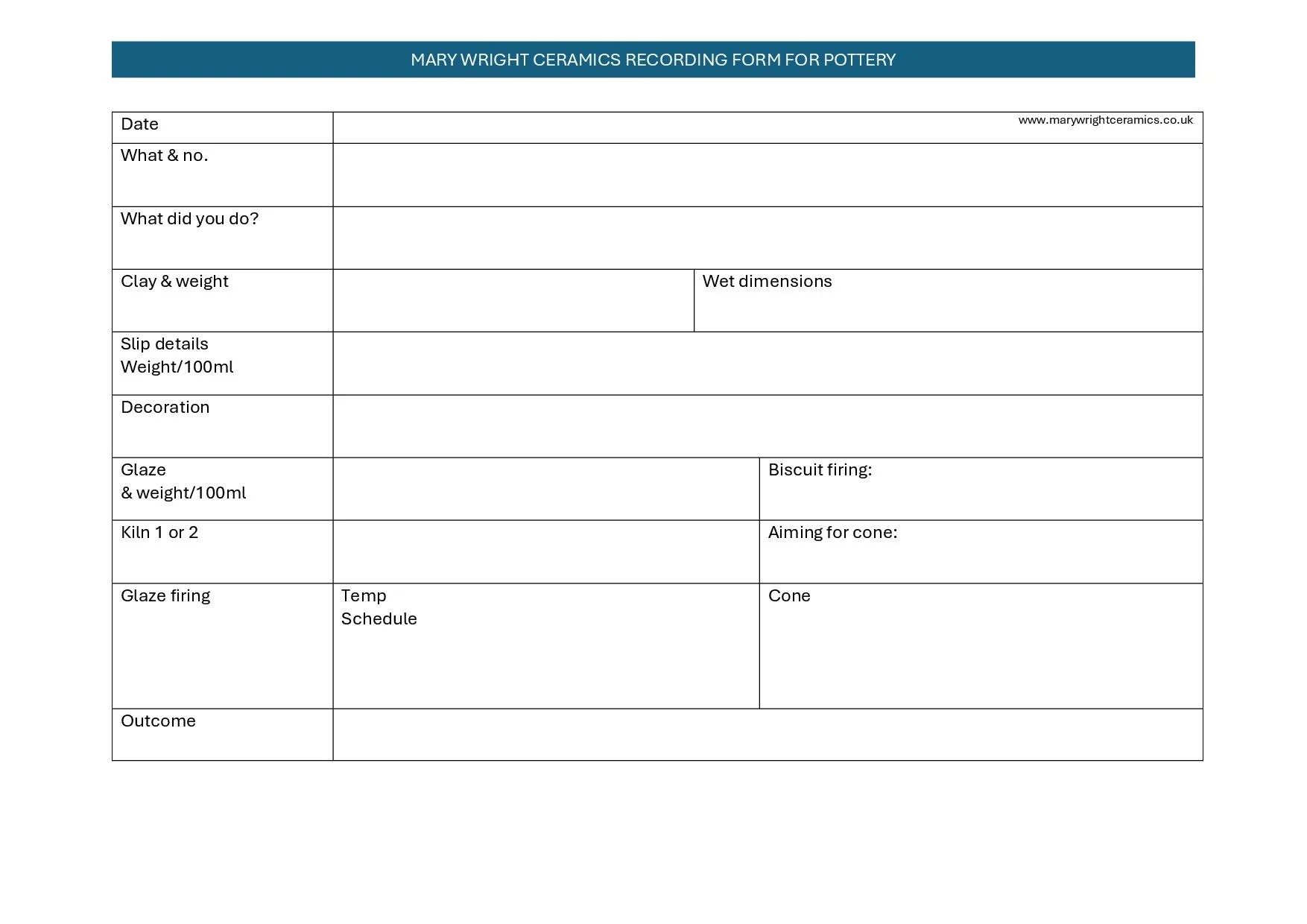
My recording form for each vessel
There are a couple of items on my form which may need explaining.
· Kiln 1 or 2: I have 2 kilns and noting which one helps me to identify patterns that occur in one or other kiln.
· Cones. These are ‘pyrometric cones’ which are an alternative way of measuring heat. Each cone is composed of slightly different amounts of alumina and silica so that they bend at different (but known) temperatures. So, by placing 3 different ones in a row during the firing, you can determine the heat work and therefore temperature of the kiln. It’s a very useful precaution as electric kilns do not always heat to the temperature that you programme them to.
· I weigh both my slip and glaze each time that I use it. While the weight isn’t the only variable which affects these coverings, it does help to maintain consistency between batches of pots.
In my later blogs I will write about my search for the creation of a red or black stoneware clay body with a white slip that covers it. This will be a dive into firings, clay bodies and ceramic materials.