Creatively, I like the idea of how an English slipware can intersect with a Korean Buncheong style of ceramics¹. As a result, I am trying to use red or dark clay bodies, similar to those used in English slipware, but firing to stoneware temperatures, as is done in Korea. I like the durability that stoneware bodies offer the user. They are ideal for domestic use being vitrified² (so they don’t absorb water) and they don't tend to chip as readily as the clay body has a greater density³.
However, there are a number of problems associated with firing a red clay body to higher temperatures. Bloating is the main one that I have encountered. This is where Red Iron Oxide changes its chemical composition during the firing at around 1150⁰C and gives off oxygen in the process. In reduction firings this isn't a problem. However, in an oxidation firing the oxygen has to escape somewhere and can cause pockets of oxygen in the clay itself, or under the slip as this stops the oxygen from being released. Here’s a photo of a bloated surface from one of my pots.
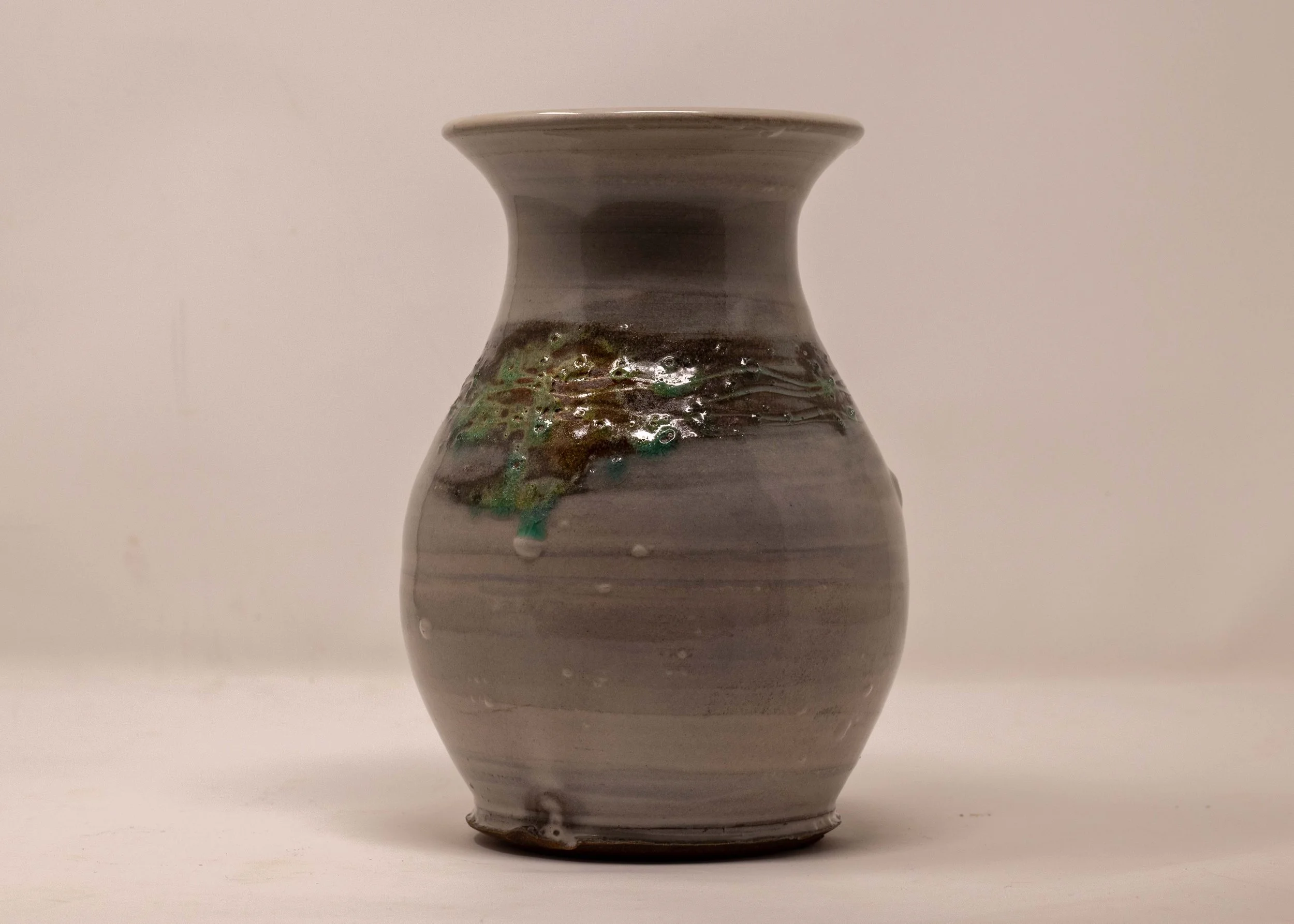
Example of a vase with bloating or blistering with the glaze and slip pulling away from the clay body underneath
These problems have led me to perform many different tests to try and find a solution to the problem.
Firstly, I have tested lots of commercially sold clay bodies, a good number of which I have mixed together to see if any can work at higher temperatures, while still retaining the colour that I'm interested in. My New Work is formulated using one of these mixtures, but before I found this one, I tested many others. I was delighted to see no bloating or blisters on many of my first pieces using my current mixture. These pieces tended to be smaller with thinner walls – after all, clays costs money and I didn’t want to use more than I needed in a test.
This lulled me into a false sense of security. As my tests got larger, the bloating started to reappear. So I started looking again at other white clays that I could mix with my dark stoneware clay, just in case that sorted out the problem. As nothing seemed to really be working, I decided to look at other variables, more subtle ones that I have noticed through observation of these endless tests.
In particular I became interested in wall thickness and the shape of the pots. Thicker walls and more enclosed forms appeared to particularly cause the problems. I think that this makes sense given the theory that it is Red Iron Oxide giving off oxygen during the firing. There is simply more Red Iron Oxide in thicker walls and there is less air around in a more enclosed form, to allow for the chemical reaction to take place. In relation to the mixture using commercial clay bodies, this is still somewhat a work in progress. I open every glaze firing with a certain amount of trepidation, not knowing whether there will be blisters on the larger pots or not.
¹ Korean Buncheong ceramics. For further information please see my blogs https://www.marywrightceramics.co.uk/blog/buncheong-back-to-korea-and-a-bit-of-history and https://www.marywrightceramics.co.uk/blog/slip-glorious-slip
² vitrification ‘[following firing] the original clay particles are wedlded together by a glassy matrix which almost fills up all of the interstitial spaces’ Hamer,F & Hamer, J ( The Potters Dictionary of Materials and Techniques 6th Edition Bloomsbury 2014
³density measured by the formula g/cm³