For two weeks in September, I visited South Korea. The intention was to see Korean ceramics and particularly Buncheong ware in a variety of contexts, as well as get a sense of what the Korean culture is like, given my ceramics is informed by this type of pottery. The technique uses a dark clay under a white slip. The slip is used in a variety of ways which I will touch on later.
During my time in Korea, I visited various museums in Seoul and beyond. South Korea is a country that takes pride in its culture, both current and historical, and the spaces that housed their cultural treasures were impressive in their architecture.
During my visits, I immediately fell in love with the round clay tiles that were traditionally found on the end of roofs. These decorative round tiles were a repeating theme throughout my journey, and I hope to incorporate them into my own work in some way.
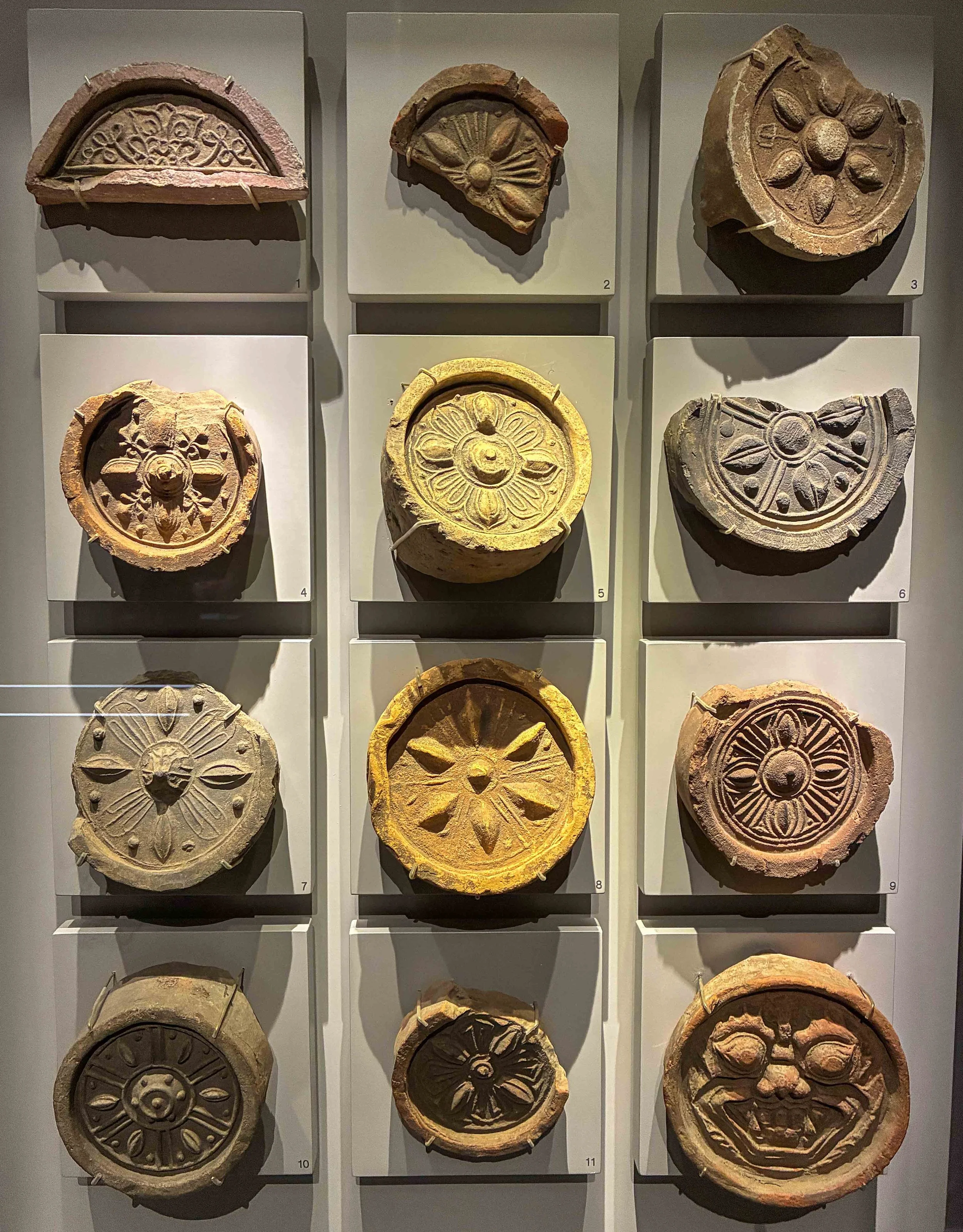
Historic Roof Tiles
It was wonderful to see ceramics and other forms of craft; lanterns, masks, metal work and textiles to name but a few. One of the things that struck me was the strong sense of visual form in Korea. There are the same ceramic forms that were present in almost all of the museums that I visited – maebyeong jar, onggi jars, barrel bottles, types of teacup. These are the visual themes that repeated themselves over and over. I wondered whether this was because in the past all of society was influenced by Confucian ideas correctness, of which one of the was consequences that the Court had everything made to a prototype. So, when a new item was made for court, there was a specific prototype that dictated its dimensions, structure and materials. In terms of my own ceramics journey, I have started to wonder what forms we have in the UK that are ubiquitous? I don’t think that we have such a sense of sameness here, but I am looking into the themes in British ceramics.
I saw pots from around the country. Excitingly, some were National Treasures which are exceptional examples of a particular type of object, the ones that I noticed were of course, ceramic. It was clear to me that you could see a greater breadth of ceramics in Korea when compared to the Korean exhibitions and examples of Korean ceramics in the UK. It felt well worth the effort to visit in this respect.
Over time, the ceramics in Korea has changed – from using celadon glazes to Buncheong ware to porcelain. I was particularly interested in looking at the various forms of Buncheong ware, seemingly from different areas of the country. Some were with iron decoration over a white slip, sometimes inlayed with white slip, others using sgraffito through a white slip. And sometimes white slip simply poured or dipped or brushed on a vessel. Fully understanding this variety has helped to open up different ideas for my own work.